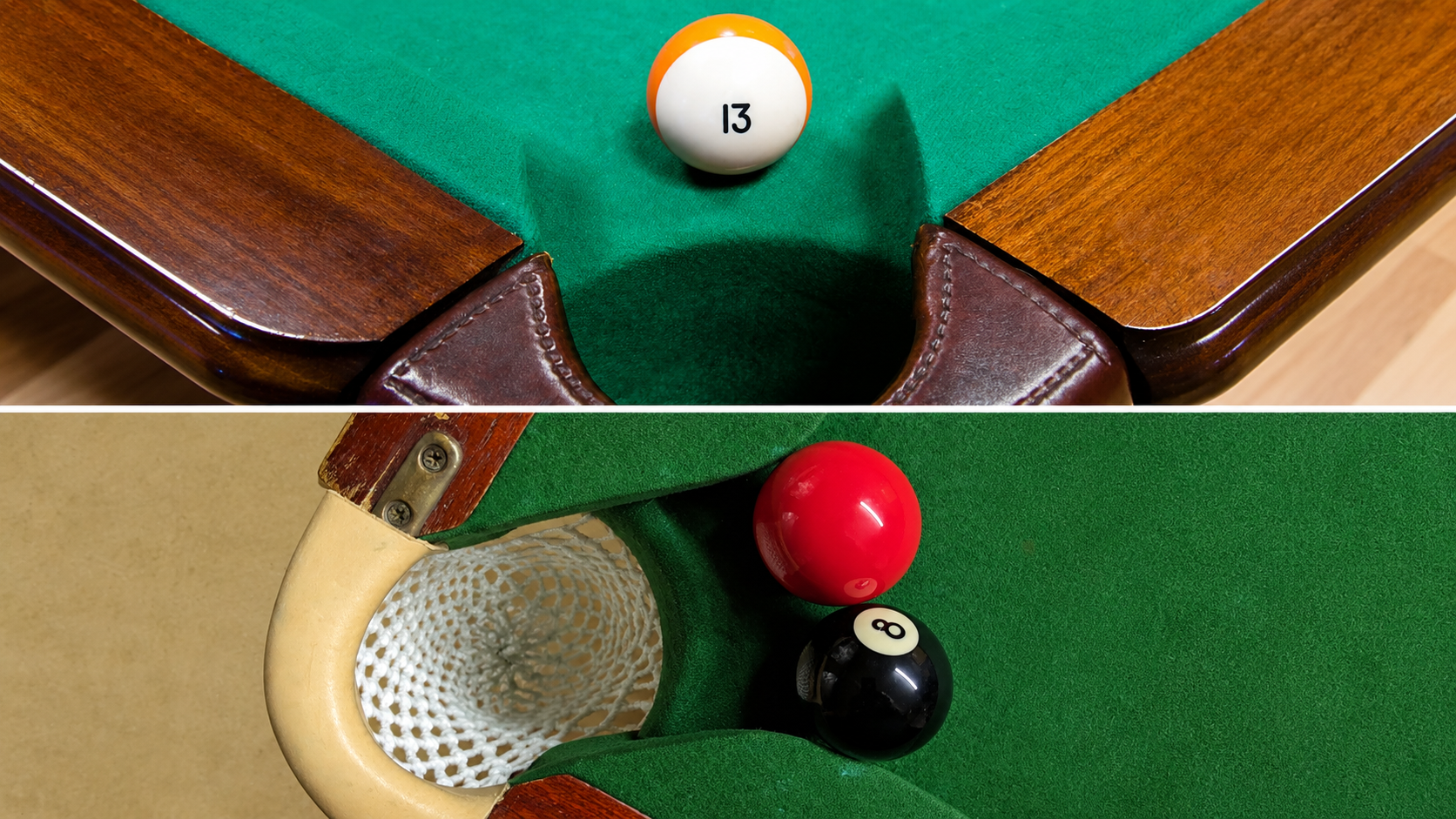
I've owned it since 1994. It fits like an old glove. I wanted it with me in Waterloo, on my parents' table — the same table my dad scooted me around on a kitchen chair before I could see over the rail. I wanted it every morning at the Cedar Falls community center, where my parents now play.
Coming home to Portugal from this trip, I realized how much I miss playing pool. Not just any pool. American pool. And it reminded me how much I dislike playing the European version — or, let's call it what it is, miniature snooker.
The Difference
Most people don't know there's a difference. There is, and it changes everything.
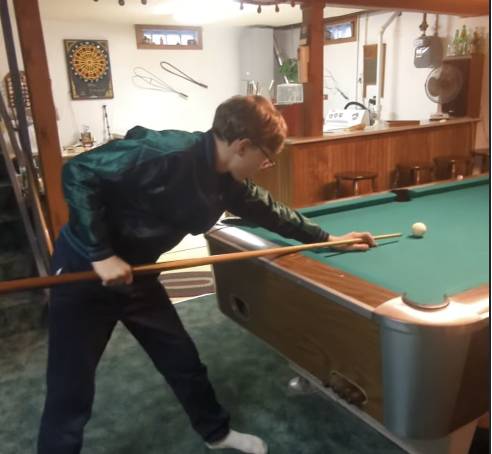
American corner pockets are cut wide and angled. Snooker corners — and what passes for pool in Portugal is really miniature snooker — are rounded and tight. The side pockets tell the same story: forgiving on one table, pinched on the other.
That geometry decides the whole game.
Snooker pockets want a soft hand. Slow speed. Surgical aim. Precise, polite, and as exciting as watching cricket. I respect the discipline. I just don't want to play it. I want to be loud. I want to be animated. I want to make the cue ball dance around the table.
American pockets let me. They give me room to put hard spin on the cue ball and trust the pocket to forgive what the spin does to the object ball.
Here's what that means. Say I want to make the 7-ball in the corner, but my next shot is at the other end of the table. If I hit the cue ball dead center, it dies right where the 7 was. So I need to put extreme right English on it — make it spin.
Imagine the cue ball is a clock. The tip of my cue strikes at 3 o'clock. That's extreme right English. The cue ball spins counter-clockwise, hits the 7, and the spin transfers in the opposite direction — the 7 drifts slightly left on its way to the pocket. If you've played long enough, you know that drift in your bones. You aim a hair right of where you'd aim with a center-ball hit, and the wide American pocket swallows the rest.
Try that on a snooker table. The pocket rejects you. Slow down. Shoot softer. Be precise.
Have a tea while you're at it.
CF Community Center
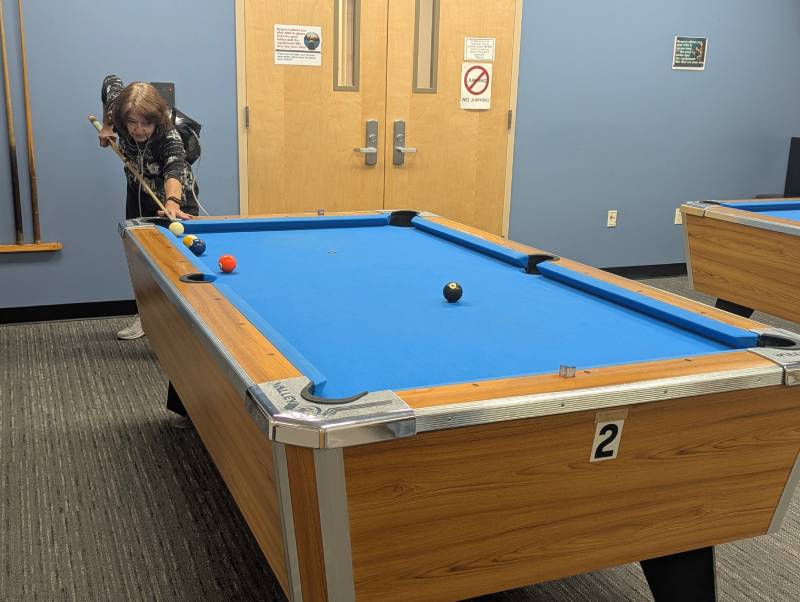
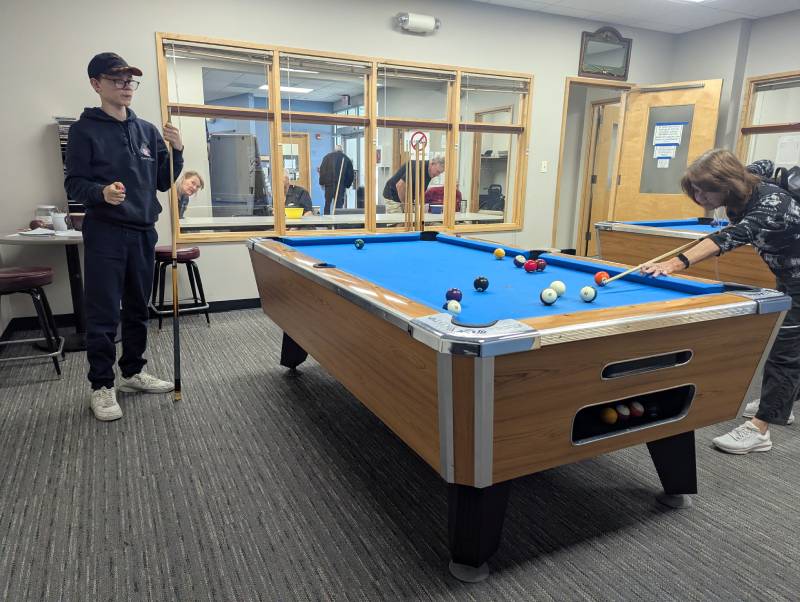
We played every morning at the Cedar Falls community center. Three Valley tables. Free play. The old bar-league guys from my dad's generation and beyond play there now — eighties, nineties, still racking.
The shit-talking has not slowed down.
Marshall used to play at my dad's house. He has dementia now. He can't always remember where he lives. He hasn't forgotten the bridge, the stroke, or the comeback line.
Soren came with us. He hasn't played much pool in his life, but we turned him loose with these guys, and they did not take it easy on him. Five days in, he was holding his own. The one habit he couldn't shake was firing too fast — set, shoot, no read.
My parents told him to slow down. I told him to slow down. He didn't.
Then he played Marshall.
Marshall watched one rack, leaned on his cue, and looked at him. "Oh my god, Soren. What are you going to do with all the time you saved from shooting that fast?"
Soren slowed down.
It takes a village.
Piper
Then there's Piper.
Piper is ninety-nine. He started playing pool in his eighties and credits the long-timers at the center for teaching him. He beat Soren most mornings.
I met him last July and sat in my chair trying to think of what to ask a man who's lived that long. The wisdom must be in there somewhere. My mind went blank. I just watched him play.
This visit I learned more. Piper is a World War II veteran. Drafted into the Navy. Sixteen weeks of gunnery school. The war ended before he finished. The Navy moved his whole class to Hawaii for eighteen months of recreation duty — running the leisure time of servicemen on leave — and then sent him home.
"Easy gig," he said.
In 2026, I was talking to a WWII veteran across a pool table.
On our last day, I looked up in the parking lot and there was Piper in the driver's seat of his own car, waving. Ninety-nine. Still drives. Still lives alone. Still buys his own groceries.
I asked him his recipe.
"Don't worry. Don't hurry. Don't overeat."
I don't worry much. The other two I break daily.
Mom
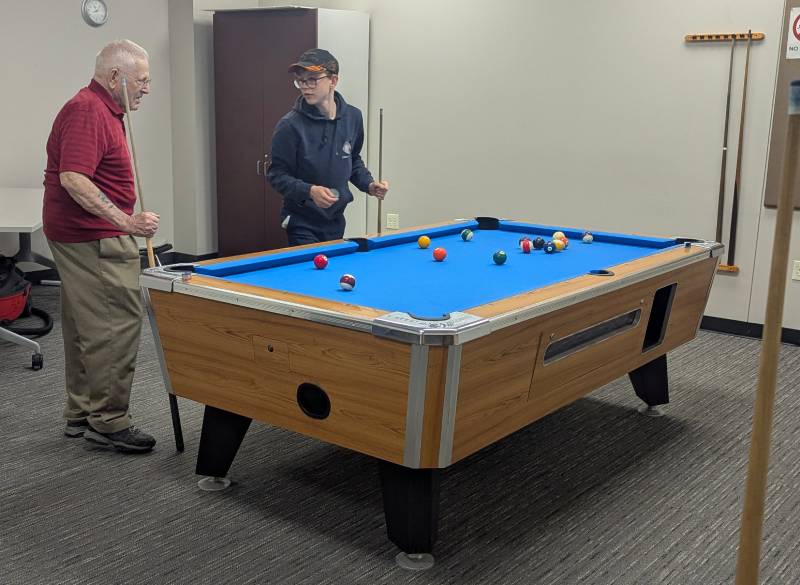
Growing up, she wasn't a pool player. She'd pick up a stick now and then to round out a doubles match with my brother Jason and my dad, but it wasn't her game.
In retirement, she joined the women's league at their community in Mesa. Her form is clean. She's dropping shots she had no business making thirty years ago. All of it with a portable oxygen tank slung over her shoulder.
The Game
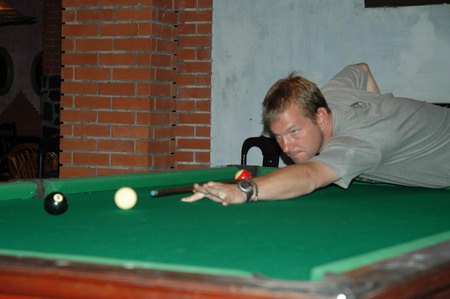
I still miss the puzzle. Reading the table. Making a plan. Watching it execute.
I can't get as low on the cue as I used to. Chemo tightened the muscles in my back. My eyes have softened too. I haven't figured out how to play in my glasses, so I take them off and let the balls go a little blurry — think Paul Newman in The Color of Money.
The feel hasn't gone anywhere. Ten thousand hours don't unlearn themselves. My stroke might be better now than it's ever been. I credit golf — years of fighting that game and losing have somehow paid out at the pool table.
My golf game is still shit.
The Cue
I left the cue at my parents' house.
I told my dad not to program it with his bad shots. I've spent thirty years programming that cue.
He tried it a few days after I left. Too long. Too heavy. He set it back in the rack.
It's waiting for me.