1995
"Let's go climb the Kate Shelley Bridge. We'll rappel off it before sunrise."
Steve tossed his keys on the counter, and the night was already over — or should have been. We'd just come back from a party. Nothing special. Restless, wired, not ready to sleep.
He'd taught me to rappel six months earlier. His father had climbed the same bridge with two-year-old Steve strapped to his back. Steve was studying veterinary medicine now, like his dad had. None of that was why he wanted to go. He wanted to go because it was high, remote, and still active.
We skipped more drinking and started prepping gear instead. By 4:30 a.m., we were on the road for the half-hour drive to the bridge. We parked as close as we could and set out across a dewy field under a thin layer of mist.
About a quarter-mile in, we reached a wire fence. I reached out to lift it — and instantly every muscle in my body locked. The jolt from the electric fence hit through my glove, snapping me awake faster than any coffee could. I froze, half-expecting another shock, then laughed in disbelief.
Not eager to test my luck again — or relive the "stake incident" from six months before — we followed the fence line until we found an opening and crossed through.
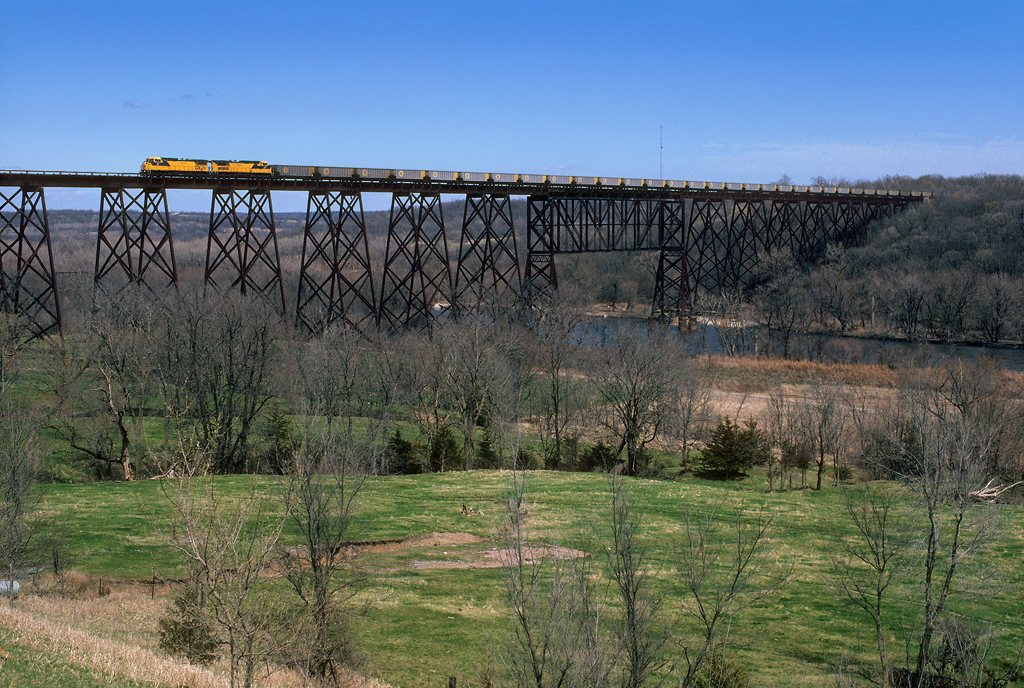
The bridge loomed ahead, rising nearly 190 feet above the river valley. Up close, its lattice of iron supports crisscrossed — diagonal beams intersecting in tight Xs, stacked layer upon layer until they disappeared into the fog above.
Steve didn't hesitate. "Let's go," he said, knowing daylight would ruin our cover. He started climbing, and I followed.
The first section felt awkward — like scaling a tilted ladder where one side sat lower than the other. The metal was cold, slick with mist, and every step demanded attention. I kept three points of contact at all times, repeating it like a prayer.
When we reached the first set of crossed beams — the Xs that framed the bridge like a web of steel — I had to climb out and over one of the diagonal braces, a narrow wedge of rusted iron that slanted into the next joint. Each crossing meant stepping into open air, gripping cold, slick steel, and hauling myself across. I wasn't tied in. One wrong move and I was gone. "Three points of contact," I whispered again until I cleared the final X. Thankfully, there were only three of those crossings.
By the time I reached the second, I could see Steve above me making a tricky move up to a small maintenance platform about three-quarters of the way to the top. Seeing him reach it was a relief. One more dangerous maneuver stood between me and a solid footing. The final stretch required upper-body strength — a full pull-up to hoist myself onto the platform — and the metal was slick with mist.
Steve tossed a rope down and anchored it above, giving me a safety line. Falling would hurt, but at least I wouldn't die. I climbed up without incident, joining him on the two-story maintenance platform. Two flights of stairs led upward, like the exterior fire escapes you'd see on old city buildings — a welcome change from clinging to the side of the bridge. Steve was far ahead of me, and I followed him toward the top, where I found him on a narrow platform searching for a place to tie off the rope.
The plan was never to reach the top. That was too dangerous with trains still active on the line, and we had no idea how often they came through. Instead, we aimed for a smaller platform about six feet below the tracks — a steel slab roughly the size of a bedroom door. We crouched there, double-checking our ropes, when a low rumble rolled through the valley.
I stopped tying off. "Is that a train?"
Steve froze. "No… not now. Not while we're here."
But the sound grew louder. Then came the vibration — faint at first, then unmistakable.
"Shit — it's coming! Brace yourself. Stay low. Don't let anyone see you!"
The rumble turned into a roar. I dropped to my knees, pressed my palms and face flat against the cold steel, and hugged the bridge as tight as I could. I pressed my cheek to the rusted metal; my shoes braced on a narrow beam. I'd expected the wail of a whistle — but this wasn't a crossing. There was no warning.
The headlights cut through the mist, blinding white and closing in fast. The bridge began to sway, the vibration rolling through the steel and into my chest until my heartbeat fell into rhythm with it. I pressed closer to the metal, cheek against the rust, breath fogging the cold iron.
Then came the sound — a deep, building thunder that swallowed everything else. The air thickened with the smell of diesel and wet steel. I couldn't see anything but light and motion. The mist hit my face in bursts, sharp and cold.
The noise was deafening — the kind that rattles your teeth and leaves no space for thought. The bridge hammered now, each pulse of the wheels driving through the iron beneath me. Duh-dun. Duh-dun. Duh-dun. Over and over, faster, louder, endless.
Time stopped meaning anything. There was only the rhythm — duh-dun, duh-dun, duh-dun — echoing through the valley and through me. Every passing car screamed by like a burst of wind and water, and still the train didn't end.
I held my breath, pressing my hands towards the steel until my arms ached, waiting for the final car, for silence, for anything other than this pounding chaos.
And then — it came. The last duh-dun faded into the mist, swallowed by distance. The bridge still trembled beneath me, but the roar was gone. The silence that followed was louder than the train itself. I exhaled, realizing I'd been holding my breath the entire time.
"Let's get the hell out of here," Steve said.
We waited for the vibrations to fade before setting up for the rappel. Steve, the "professional," took charge, rigging the anchors and threading the ropes with practiced precision. My job was simple: hand him the gear and don't drop anything.
After ten minutes of double- and triple-checking knots, we were ready.
"You go first," he said. "I'll need to recover my rope at the end."
I nodded as he dropped the loose end of the rope into the mist below. "Did it hit the ground?" I asked.
"Yeah — it's long enough. Just slow down near the bottom to make sure."
That was… encouraging. Not exactly comforting, but I didn't have another option.
I threaded the rope through my Figure 8 descender, careful not to twist or cross the lines. The metal felt solid in my hands — cold, trustworthy. I clipped it to my harness with a locking carabiner and tugged twice to test the tension.
"Wait — is my knot right?" I asked for the third time.
Steve laughed. "Your knots are fine. Go!"
I locked my right hand on the rope at my hip — the brake hand — and eased back until I was sitting in the harness. My shoes slipped off the edge, and I swung out into nothing. Suddenly, I was hanging over the void. For a heartbeat, my body refused to move. Then muscle memory took over. I let the rope feed through my hand — brake, release, brake — and started down.
The mist swallowed me. The hum of the bridge faded. I locked into the rhythm — brake, release, glide. The rope hissed through my gloves as I dropped lower, the smell of wet metal and river mud rising to meet me.
When the ground finally appeared, I saw the rope coiled in the grass like discarded cable. I eased off the brake completely and dropped the last few feet, landing with a thud.
"I'm down!" I yelled.
A few minutes later, Steve followed — his descent smooth and controlled. He somehow retrieved his rope on the way down, pulling off another minor miracle. When he landed, part relief, part wild grin, part disbelief that we'd actually pulled it off.
The first light of morning filtered through the mist as we packed up our gear. The bridge had already begun to disappear again — its outline thinning into fog, as if it had never been there at all.
We didn't say much on the drive back.