
Stage IV colorectal adenocarcinoma — the history, the biology, and where things stand
Where things stand
Chemo closed at 9 rounds of FOLFIRI — final round June 4, 2026CRS+HIPEC surgery July 15, 2026, Champalimaud (Lisbon) — CC-0
Pathology July 28, 2026 — PCI 5
Now: recovery and surveillance, scans every 3 months
My Cancer
This page documents the history and biology of my cancer and how it was treated. Active treatment ended with surgery in July 2026. The treatment timeline has the dates; the pages under Chemo Tools are what I used along the way.
A note on language: I use clinical terms here because they're precise. If something is unclear, a quick search will get you there faster than me over-explaining it.
Cancer History
Cancer 1 — Thyroid (2019)
My first cancer was papillary thyroid carcinoma, detected after an ultrasound flagged suspicious nodules during a routine checkup. Surgery removed the left lobe of my thyroid. Pathology confirmed a 1.4 cm papillary carcinoma — slow-growing, high survival rate, clean margins. The right lobe remains and has been under regular surveillance since.
That cancer scared me because of the surgery, not the diagnosis. It went well. I went back to work. I filed it away and moved on.
Cancer 2 — Colon (2024)
In May 2024, I went to a Portuguese emergency room with acute abdominal pain. A CT scan and diagnostic procedure identified a mass involving the cecum — the junction where the small intestine meets the colon — along with a perforated appendix. I was treated with antibiotics and discharged for elective surgery.
In June 2024, a robotic-assisted right hemicolectomy removed the right half of my colon along with the primary tumor. The appendix came out with it.
The tumor was classified as Stage IIIC colorectal adenocarcinoma — moderately differentiated, with spread to three nearby lymph nodes and breach of the outer wall of the colon.
Following surgery, I completed 12 cycles of FOLFOX chemotherapy over approximately six months. Treatment intent at that stage was curative. Oxaliplatin — one of the three drugs in FOLFOX — was removed from the regimen during treatment. Remaining cycles were completed on a two-drug regimen.
Recurrence — Peritoneal Carcinomatosis (2025)
Nine months after completing chemotherapy, follow-up imaging detected cancer again. Small deposits had formed on the peritoneum — the lining of the abdominal cavity — near the liver capsule and in the pelvic region. This is called peritoneal carcinomatosis. It is not the same as liver metastases. The liver itself remained clear.
This reclassified the disease as Stage IV. Second-line chemotherapy with FOLFIRI began in December 2025.
Response to Chemotherapy (early 2026)
Early 2026 imaging showed significant improvement. A PET scan showed apparently complete metabolic response — the peritoneal deposits were no longer metabolically active. An MRI confirmed the implants had shrunk substantially; the largest went from approximately 28 mm down to 15 mm. All implants reduced in size. No new lesions appeared.
That response is what made surgery an option. Chemo was stopped after nine rounds, in June 2026, to move to surgery.
Surgery — CRS+HIPEC (July 2026)
On July 15, 2026, I had cytoreductive surgery with HIPEC at the Champalimaud Foundation in Lisbon. The surgery reached CC-0 — no visible tumor left behind. Pathology on July 28 scored the Peritoneal Cancer Index at 5 (out of 39). What CRS+HIPEC is and how I chose a center each have their own page.
Now — Recovery and Surveillance
No active treatment. Surveillance scans every three months. The job now is rebuilding — body, routine, family.
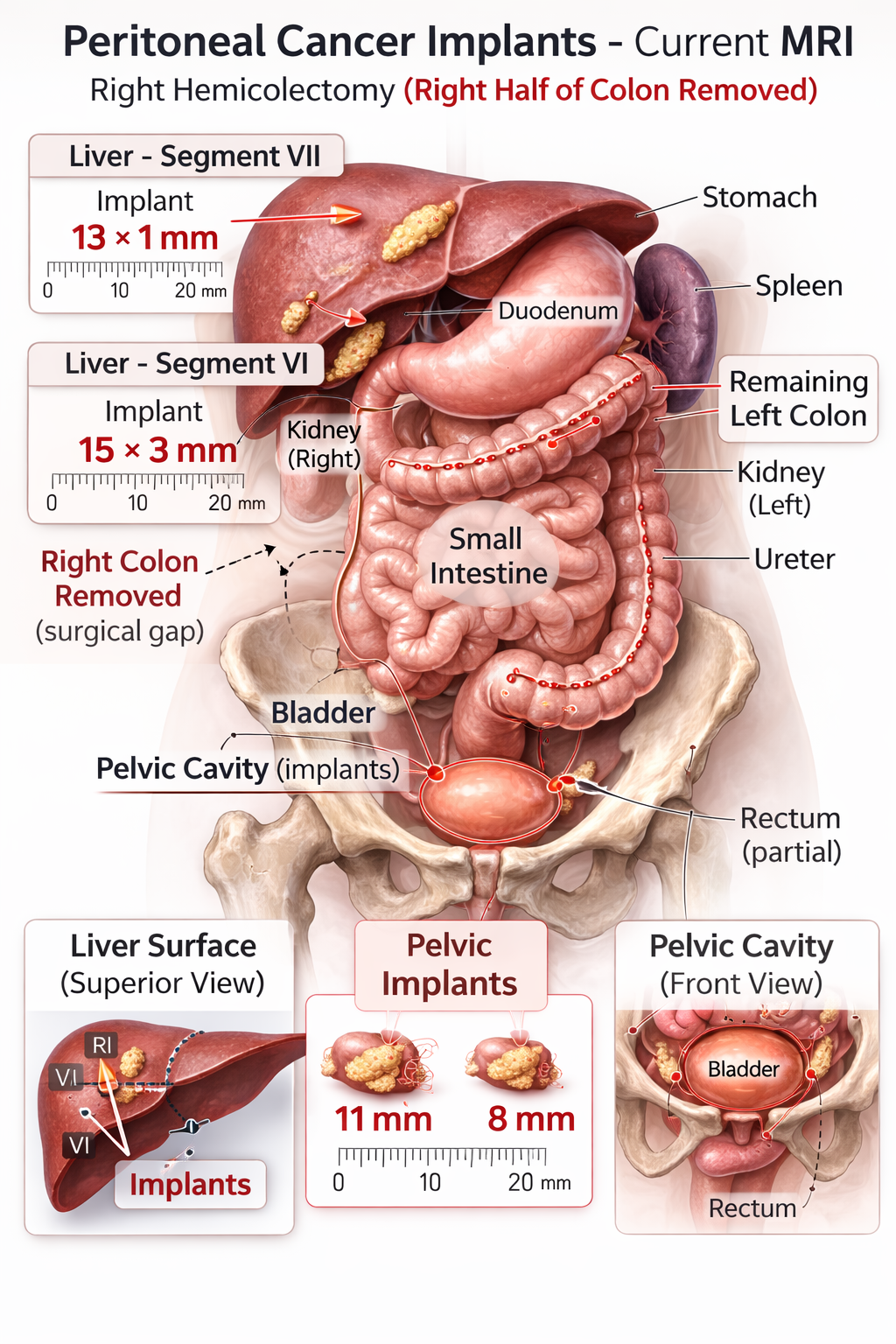
Imaging Interpretation
Multiple modalities were used to monitor disease. Each measures something different and results should not be conflated.
- PET scan: Measures metabolic activity. A PET-negative result does not mean cancer is absent — it means lesions are not hypermetabolically active at that moment.
- MRI / CT: Measures structural anatomy. Used to track size and location of lesions over time.
Before surgery the picture was: structurally shrinking, metabolically inactive. That's the best result you can hope for at that stage, and it is what qualifies you for CRS+HIPEC.
Tumor Biology — Genomic Profile (FoundationOne CDx)
Tumor tissue was analyzed using FoundationOne CDx, a comprehensive genomic profiling test that evaluates hundreds of cancer-related genes to identify driver mutations, biomarkers, targeted therapy eligibility, and clinical trial matches.
Key Findings
- KRAS mutation: G12V
- MMR / MSI status: MSS / pMMR (microsatellite stable; mismatch repair proficient)
- Tumor Mutational Burden (TMB): 4 muts/Mb — Low
- HRD status: Negative
- BRAF mutation: None detected
- ERBB2 (HER2) amplification: None detected
Clinical Implications
- KRAS G12V: Predicts resistance to EGFR inhibitors. Cetuximab and panitumumab are not viable options. KRAS-specific drugs exist for a different mutation (G12C) and do not apply here.
- MSS / pMMR + Low TMB: Immunotherapy (checkpoint inhibitors) is unlikely to be effective and was not indicated.
- No other actionable mutation: No approved targeted therapy was identified. Standard chemotherapy remained the primary systemic treatment.
Why Genomic Testing Still Matters
Even without an actionable mutation, comprehensive genomic profiling provides value: it eliminates ineffective therapies, pre-screens for clinical trial eligibility, and establishes a documented molecular baseline. That data is archived and available if the picture changes.
Chemotherapy
First Regimen — FOLFOX (2024–2025)
- Cycles completed: 12
- Intent: Curative at time of treatment
- Outcome: Disease recurred in the peritoneum approximately nine months after completion
- Dose adjustment: Oxaliplatin was removed from the regimen during treatment. Remaining cycles completed on leucovorin + 5-fluorouracil.
Second Regimen — FOLFIRI + bevacizumab (Dec 2025 – Jun 2026)
- Schedule: Every 14 days
- Cycles completed: 9 of a planned 12 — stopped early to move to surgery
- Dose adjustment: Regimen reduced approximately 30% due to elevated liver enzymes.
- Cycle pattern:
- Day 0: ~5+ hour infusion clinic visit, followed by 48-hour portable pump
- Days 1–2: Peak fatigue, nausea, cognitive fog
- Day 3+: Gradual recovery window until next cycle
The nutrition calendar and supplement review were both built around that 14-day pattern.
The Thyroid — Still Watching
The right thyroid lobe — the half that remained after 2019 surgery — showed elevated metabolic activity on a 2026 PET scan. This is a separate finding from the colorectal cancer. The differential includes inflammation from an existing thyroid condition or a new lesion in the remnant tissue. It did not change the colorectal treatment plan.
Treat. Scan. Adjust. Repeat.