* * *
May 24, 2005
The immigration officer in Huay Xai held out his hand for thirty baht.
I started reaching for my pocket, then stopped. Why am I paying this guy? He must have read it on my face, because he turned a laminated card around so I could see it.
Office Hours 8am–6pm
Overtimeee Fee 15 baht 4pm–6pm
Overtime. Spelled with three e’s. We’d crossed the Mekong from Thailand an hour before — forty baht for a longtail across the border — got our arrival stamps, filled out the paperwork. Now the same man who’d just stamped us in wanted a surcharge for working the hours he was already standing there working. A racket, printed and laminated. I paid it. You have to admire the confidence.
Huay Xai is a one-street border town. We found a guesthouse within ten minutes and spent the evening on the porch with a German couple twelve months into their own trip, three weeks from going home. They had the look — loose, unhurried, a little sad about the calendar. We booked our boat through the guesthouse. Four thousand baht for the two of us: one day down the river to Na Lee, then a truck the rest of the way to Luang Namtha. Leave at eight, off the water by dark, in town that night. One long day, the owner said.
I figured a single day meant rough. I didn’t know it meant this.
A kid, maybe fifteen, walked us to the water at eight the next morning and pointed at a long, narrow wooden boat, low to the water. We climbed in and sat on the floor. No other foreigners. Another boy, maybe fifteen as well, sat across from us in a Linkin Park T-shirt, and Tina asked if he liked the band. He just looked at her. Nobody on that boat spoke a word of English. From the first push off the bank, we were running on hand signals and grunts.
Fifteen minutes in, the boat nosed into shore, and a small man — he looked like a leprechaun — turned and started asking me for something. I thought money. He kept at it until we caught it: passports. He took ours, jogged up a hill into a cluster of huts, and vanished. Tina and I looked at each other. Well. There go the passports. A few minutes later, he came back down grinning, handed them over, and hopped aboard. A checkpoint, we decided. We’re still not sure.

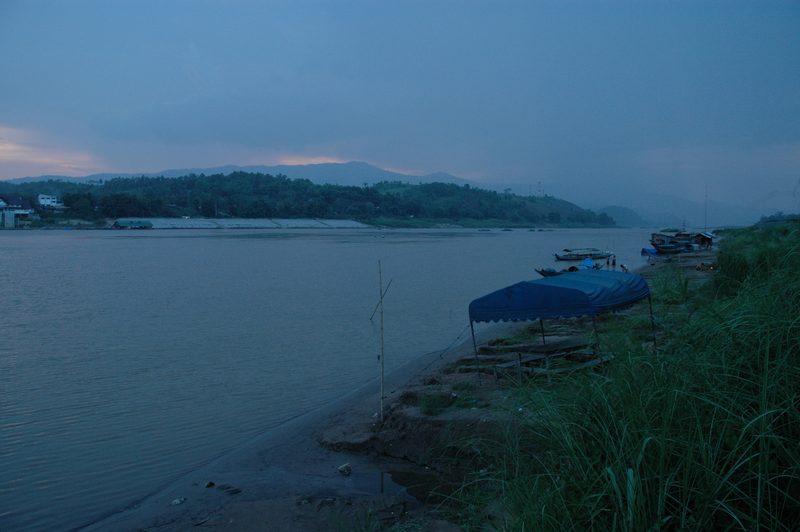
The Mekong ran wide and brown between banks of slate that rose straight out of the water. It reminded me of the backwaters of the Mississippi, where I used to waterski at my uncle Dean’s cabin, except the Mississippi never grew cliffs like these. Every few bends, we stopped to take on cargo. Eight bags of cement. Two squat toilets. Crates of eggs. Things I couldn’t name. The boat rode lower with every load. I wasn’t sure the thing could still float.

I dug out a pen and notebook to get the details down while I had them. A girl, four maybe, edged toward me and offered up the only word she had for me. “Pen.” I held it out — you want this? — and tore her a sheet of paper to go with it. The grin that broke across her face was worth more than the pen.

At one stop, a dozen boats sat nosed into the bank, all of them loading the same freight: eggs, cement, roof tile. Tina needed a bathroom badly. We looked it up — hawng nam, same as Thai — and she asked the fifteen-year-old. He swept his arm in a slow arc across the whole river valley and said something back. Everywhere. The world was the bathroom.
Two more men climbed on with baskets of watches and phone covers, the kind of guys who’d be selling five-dollar Rolexes out of a briefcase if you dropped them in Manhattan. Then the boat turned off the Mekong and up the Nam Tha, half as wide and shallow enough to see the bottom. Oxen stood in the current cooling off. Kids swam. Bamboo fish traps leaned in the shallows, and the villages sat either right on the water or high up in the green hills.
An hour up the Nam Tha, we pulled in where two huts sold food. The family bought the makings of lunch; Tina and I ducked into the bushes. I bought a fat bag of lychees for 5,000 kip — fifty cents — and we ate them as the boat went, the fifteen-year-old taking a share.
Twenty minutes on, we stopped again, and the driver pointed two fingers at his mouth. Lunch. I climbed out hunting for a spot to eat our lychees and a granola bar, but he waved us over to where the family had already started. Sticky rice in one tub, noodles in another, a bone in some broth, a dish of ground green chili. Tina tried the phrase for I only eat vegetables — khnuy kin tae phak — and they nodded like they’d caught about half of it. I watched and copied: grab a wad of rice, roll it, dip it in the chili. Then the noodles — fingers, head back, drop them in. The noodles ran hotter than the chili. Tina stuck to plain rice. I put our lychees in as a contribution. Ten minutes, and we were back on the floor of the boat.
For the next six hours, it didn’t stop. We rearranged our backsides on the thin mat, slathered on sunblock while the locals laughed at us, and got fried anyway. Then the river went shallow.
The fifteen-year-old and the small man stood at the bow with eight-foot bamboo poles, reading the water, steering the long boat between rocks I was sure we’d hit. We didn’t. The three of them — those two and the driver — worked it like they’d done it a thousand times, which they had. When the poling stopped working, they jumped out and pushed. Then I was over the side too, up to my shins, shoving an overloaded boat through the shallows. Tina climbed out after me. The two salesmen sat on their sacks of cement and watched. Nine hours on a river that was supposed to take eight, and we were the ones in the water. So this is what slow travel actually costs.
We dropped one man, his wife, and their baby at a quarter to six. The last passenger at six fifteen. The light was going. We were supposed to be off the river by dark. Nobody had said a word about sleeping anywhere. Soon, we kept telling ourselves. It kept not being soon. Then, just before full dark, the boat pulled into a village, and the family started unloading — the cement, the eggs, our backpacks. Our backpacks. Kids and pigs came down to the water to look. I dug for our flashlight and came up with the headlamp instead. The family was laughing. This wasn’t their village, and wherever it was, no one had sold us a night in it.

The mother shouldered a huge bag and led us up through pigs and roosters and oxen, me holding the headlamp on the ground to keep us out of whatever the animals had left behind. Twenty yards up, a bamboo fence with an A-frame ladder thrown over it. She went over with the bag like it weighed nothing. I followed, slower, pack on my back and daypack in my hands. I turned to light the fence for Tina — and the mother was gone. Just gone, into the dark.
Tina came over slow — wrong shoes for the wet ground, and she didn’t like being herded in the pitch dark. By the time she was across, the headlamp was the only light in all that dark, and the whole village was pressing in on us. Huts on stilts, a fire going in one of them, faces at the edge of the beam. We walked toward the huts, saying it out loud to each other — “Where did she go?” — and knew for certain now this was nobody’s idea of our stop.
The mother reappeared and steered us under a hut to set our bags down. I clicked off the headlamp, hoping the dark would make us less of a show. It didn’t. They stared at us like we were aliens. Step toward anyone and they shrank back — desperate to look, terrified to touch. “What do we do?” I kept asking Tina, who had no answer and was sick of the question, but it was all I had. She walked us up into the hut itself — the chief’s, we figured, because the crowd didn’t follow us up. Bags down, out of the spotlight for a second. Then Tina: “I have to pee. Bad.”
There was no peeing without the whole village coming along. But we still had half a bag of lychees. Tina carried them to the bottom of the steps and handed them over; the crowd closed around the fruit, and in the gap we slipped back over the A-frame ladder. I turned the headlamp on. “Ooo — watch the —” Too late. “I just stepped in pig shit.” She scraped her foot in the dirt, and we went five feet from three sleeping piglets. Walking back, she said it almost to herself: “If my Mom could see me now.”
In the middle of the village, a single bulb hung over a chalkboard. Grown men and women sat with pencils and paper while a teacher tapped the board and they repeated each syllable back to him. Night school. We stopped to watch, and the crowd re-formed around us, which the teacher did not love. We knew two words of Lao — sabaidi, hello, and khawp jai, thank you — and no idea where our boat family had gone.
Tina reached into her jacket pocket, and the zipper pull came off in her hand. I lit it so she could fix it, and the crowd slid around to watch her pocket like it might produce a rabbit. She snapped it back together, I killed the light, and she said it under her breath. “Ta da.” The whole crowd laughed. Easy room.
Not knowing how else to entertain our audience, we set out to find the boat family. We found them cooking in the next hut, and they waved us up the ladder. One small pot, one candle, the cook fire. We watched them work and wondered what was coming and whether it had meat in it. Ramen noodles, sticky rice, two hard-boiled eggs. The broth was almost certainly beef, the water straight out of the Nam Tha, but it had boiled, so Tina sucked it up and ate the noodles. Off to the side, the family ate sticky rice with canned sardines and something I couldn’t place.
The fifteen-year-old came in with a root he’d just pulled, cut down the sides with his knife, and showed us how to eat it. We ate the wrong part. Bitter enough to make my eyes water, and they laughed. Tina quoted Ralph Wiggum: “It tastes like burning.” They set us straight on which part to eat. It still tasted like burning. We finished it to be polite.
We sat there talking about the food and what we’d dropped into the middle of, until I caught myself. “Why are we whispering? They can’t understand us.” We kept whispering anyway, in case they understood more than they let on. Turned out our hut was connected to the one with our bags, so we didn’t have to face the crowd again. Two four-inch mattresses side by side on the floor, a rolled blanket for a pillow between us; the driver and the twenty-year-old lay thin mats beside us. Tina offered the driver the yoga mat we’d bought in Chiang Mai, and he took it, pleased.
An old man we took for the chief stayed up talking by an oil lamp, chain-smoking tobacco, I think, though we were in the middle of the Golden Triangle, so who knows. He blew out the lamp and slid under a mosquito net. I lay there in the dark. This is one of the most amazing things I have ever done. Tourists in Chiang Mai pay good money for a staged version of it, and the tribes there see foreigners every day. These people had never seen anyone like us. Tina leaned over and whispered, “You still awake?” “Yeah.” “Guess the time.” Quarter past nine, she said. We whispered a little longer, then quit — everyone around us was trying to sleep. I lay back and looked up into the black. How the hell did we get here? I’d talked my way into a lot of strange places. This was the farthest from anything I’d ever felt.
The roosters started at four fifteen. By five, the valley had filled with mist, and the village was moving. We carried our bags down to the river, where the family was loading the boat in the half-light.

The kids swarmed us. I pulled out the digital camera, shot one, and turned the screen around — they shrieked at their own faces and crowded in, posing harder for the next. I’d have given anything to hand them prints. Tina worked with another group on photos of our dogs. When the old man we took for the chief walked by, I gave him our deck of playing cards, pressed my palms together and laid my cheek against them — thank you. He raised a thumb to his nose and said something that sounded genuine. I decided it meant you’re a scholar and a gentleman, the way my pool partner Bob Smith used to say it back in Denver. Could just as easily have been stupid white man, I don’t know any card games.


By six, we were back on the water — the chief in with us, and nine men from the village. Twenty minutes downriver, we pulled over and got waved up a hill, everybody but the family and the driver stayed in the boat. We crested it, came back down to the water, and understood: rapids, a narrow chute, too rough to run loaded. We waited. The boat came up through the gap — the little man on the motor, the father and daughter in the middle, the fifteen-year-old and the driver at the bow with poles. They cleared the top and stuck. Too shallow to push forward, the current dragging them back toward the chute. His eyes went wide and he waved us in.
I went. All I could see was our brand-new, expensive camera going down the river with the rest of the bags. We got our shoulders into it and shoved it clear. The chief stayed behind at that village; the rest of us climbed back in, half the crew soaked, and it wasn’t even six thirty.
Twenty minutes later, stuck again. I was at the stern, pushing, when my wrist went beep beep, beep beep. The alarm — one alarm, set for seven the morning before, so we wouldn’t miss the boat that was supposed to have us in Luang Namtha by dinnertime last night. A full day later it was going off with me waist-deep in the Nam Tha, shoulder into a boat with a sheared propeller, a village we’d never meant to see somewhere behind us. I shut it off, laughed out loud, and kept pushing.
Before I climbed back in I saw the propeller — chewed to nothing — and six more in the bottom of the boat, every one of them half wrecked. The day before, each time the engine screamed, we’d stopped to “fix” it. We hadn’t been fixing anything. We’d been shearing propellers off in the shallows all day.
A couple more pushes and a couple more hours, and we reached the family’s actual village — the one we should have slept in. Men on the beach repairing a longtail called something to our crew that I took for what the hell happened to you last night. We carried freight up the hill to help. I took two bags of rice; Tina got a speaker the size of the ones that announce high-school football games. Their hut had a full stereo rig wired to a car battery, a spare battery beside it. I stood there, dripping river water on the ground.
A man who spoke a little English brought me a chair. I held up my soaked shorts to explain; he waved it off, so I sat. Then the textiles came out — he wanted to sell us as many as he could. We picked one table runner to support the cause and told him we only had baht. Tina worked him from 150 down to 100. I jogged back to the boat for the money and grabbed 200 to be safe.
The mother brought sticky rice, ramen, a bottle of our own water, and two cups of coffee that came at me black and scalding. I drank both coffees. We cleaned up and stood to leave, and she held up two fingers. Two hundred baht. For a breakfast we hadn’t asked for, the morning after a night we’d never booked. We’re getting worked. Four thousand baht in Huay Xai had bought us a boat to Na Lee and a truck to Luang Namtha — one day, no overnight, no meals. Instead we’d lost a day to a village that wasn’t on the itinerary, and now she wanted breakfast money for it, with tuk-tuk money lined up behind that.
All I had was a 50 and a stack of 1,000s. She’d never make change for a 1,000 out here. I showed her the 50 and a 1,000; she sent a woman off into the village with the big note, and we hoped it was for change. We stood by the boat and didn’t get in. A man called over, “Kip. No baht.” They talked and laughed and looked at us. I’d written off the 1,000 — and then the woman came back with ten hundreds. Tina handed the mother one. The mother started in on the tuk-tuk again. “Too much,” Tina said. The mother dropped it, and handed our breakfast hundred straight to a new boat driver.
We’d just been sold to another boat.
Great. Now we’d be paying for the truck too. We were too sour to enjoy the last two hours down to Na Lee. Kids waved from the banks, and I didn’t wave back — the day before I’d waved at every one of them. Fried, sore, down 300 baht on principle, and no idea whether we’d reach Luang Namtha before dark.
At Na Lee, a man from the boat sat us at the only guesthouse in town and pointed up the hill. “Taxi.” Going to find us one, we figured. Tina looked at the whole situation and said, “How about a Beer Lao?” After a confusing negotiation about paying in baht rather than kip, a 650ml bottle landed on the table. We poured two glasses and toasted to surviving the boat — and to at least knowing where the bed was if we got stuck here.

An hour later, the taxi was “ready” for another 100 baht for both of us, which we confirmed twice before just paying. The taxi was a Toyota pickup, they call a sawngthaew — two rows — two bench seats down the bed and a cage of two-inch pipe overhead. The pipe is there to hold onto. It would not save your life as a roll cage.
The driver tore out of town and up a dirt mountain road, 65 km/h over ruts deep enough to swallow a wheel, swerving for pigs and goats and chickens and one man walking an ox. I had both hands locked on the cage. Tina hollered the question over the engine. “You scared?” “Hell yes.” Wrong answer. She’d been calm up to then — figured that after all the dumb situations she’d watched me walk into, if I wasn’t rattled, there was nothing to be rattled about. Now she had it from me, and she grabbed the cage too. Across from me, a Lao kid hooked an arm through the pipe, rested his head on it, and slept. I tried it — eyes shut, because looking straight ahead was worse — held it about a minute, then opened them again, because if I was going to die, I wanted to see it coming. The second hour, the driver eased off, and the road improved, and I looked up at last: villages strung along the river, some of the huts with solar panels bolted beside them. We rolled into Luang Namtha around four in the afternoon.
We lost our way in a town you could cross in ten minutes — the Lonely Planet map was wrong — and found a room for two dollars a night. The shower was a barrel and a scoop: dump water over your head until you’re done. First squat toilet of my life. Tina was just glad to pee without a pig watching.

We put on the cleanest dirty clothes we had and went looking for dinner. The place across the street was closed; a woman pointed us down the road, and we found it by the music — a local Lao rapper and, somehow, the Scorpions, both at full volume. More bar than restaurant, but we were starving. Two tall Beer Laos and two curries. We passed on the snakehead soup and the pig bowel. (Snakehead, we learned later, is a fish.)
We added the trip up. Two days, 300 baht taken off us, six dollars — and it was the principle of it that stung. Then Tina set her glass down. “They must really need the money, if that’s what they have to do to get it.”
That ended the argument we’d been having with the whole day. We ordered two more.
Somewhere in there the table next to us — four Lao guys and one Chinese guy — waved me over and filled a glass to the top. We toasted to something. A minute later, again. Again, until the glass was empty, and then they filled it. I looked back at our table and Tina was sitting alone while these guys poured beer down my throat, so I asked if she could come over. We toasted to that. I don’t think we paid for another drink the rest of the night. They taught us Lao, we taught them English, their English winning easily. Every few minutes, one of them shouted the word for “half,” and you had to drink half your glass.
They kept us in fries and ran the Scorpions' greatest hits on repeat all night — their way of making the Americans feel at home.
We closed the place at half past ten. The last two standing with us were a policeman and a lawyer. We were two hundred feet from the guesthouse when an engine and some yelling came up behind us — the cop and the lawyer, doubled up on one moped, far too much Beer Lao in them, weaving off into the dark.