January 7–9, 2006
We took the 9 a.m. train from Tangier to Casablanca and learned immediately that "assigned seating" was optional at best. We never made it to the seats. The car packed out before we could get past the entry, so we stood the whole way in the vestibule by the doors, crammed in around the bathrooms with everyone who hadn't made it farther. Tina and I held that spot for three of the five hours, wedged in the middle, riding the sway of the train like it was part of the ticket price. A few people stood half outside the doors as the train barreled south.
At least we had a window.
The whole section reeked of aerosol deodorant. A man a few feet away spent most of the ride spraying it into his mouth. At first, it looked chemical, intentional, and dangerous. Eventually, we realized he was clutching his jaw, numbing what had to be unbearable tooth pain. The rhythm went on for hours—spray, wince, breathe—until it stopped, shortly before Casablanca.
At one point, I forced my way through the bodies to use the bathroom. It looked like a Western-style toilet until you noticed there was no bowl. Just a hole. Below it, railroad ties flashed past at speed.
I pissed straight onto the tracks.
Every train that ran this line had emptied onto the same rails.
Outside, the Atlantic slammed into the coast in heavy, rolling waves. Inland, farmers worked narrow strips of land, guiding sheep across fields that flipped between deep green and bare brown. Morocco didn't transition—it switched states. Fertile. Empty. Fertile again. I couldn't stop watching.
Casablanca greeted us with warm air and easy smiles. Once we dropped our bags, we headed straight for the Medina, hungry and curious.
We'd had the local bread—hot, round, a nickel a loaf, and good enough that I could've made a meal of it. But I wanted more than bread. Vegetarian options were thin, and the menus were useless unless you spoke French or Arabic, so Tina decided to skip dinner and walk with me while I went looking for whatever the locals were eating.
We found a row of food stalls—dirt floors, no frills, more county fair than restaurant. We chose the busiest one. I tried English. Nothing. Spanish. Nothing. French got me a shrug.
Photos of the menu covered the wall, taped at the corners. I pointed to a sandwich with fries.
A customer nearby leaned over.
"Do you need help?" he asked in English.
Yes. I did.
He translated, ordered for me, then introduced himself as Mohamed. We told him we were American, eleven months into a trip around the world. That held his attention. He asked where we'd been, where we were going, and listened as the answers mattered.
After we ate, he said, "I'm meeting a friend at a café. Would you like to join us?"
This was the moment I paused.
Not alarmed. Not scared. Just the pull of saying no feels heavier than saying yes.
We had no plans. And after nearly a year on the road, our edges were worn down.
We said yes.
At the café, Mohamed introduced us to Brahim. Brahim didn't speak English, but he followed along. The conversation ran in a triangle—English to Arabic and back again. Slower, but deliberate. We talked about work, family and travel. At one point, Brahim mentioned he liked to play pool.
That got my attention.
That night ended with tea and conversation that felt unforced. No sales pitch. No angle. When they walked us back to our hotel, they asked if we wanted to spend the next day with them.
We said yes again.
The next morning, we met under a cloudless sky and took a local bus to their neighborhood. They showed us where they lived and worked, then led us to a small seaside café.
There was a pool table in back.
Brahim remembered the night before. We played. The table was tighter than I was used to, and the pockets smaller. Different rules. Same language.
He won two games to one.

After that came tea, conversation, and word that Brahim's mother was making us lunch.
Then the food started coming, dish after dish. The night before, we'd been strangers in a sandwich line.
Vegetable tajine. Eggplant, potatoes, peas, peppers, green olives. Rice with corn, carrots, raisins, peas. Homemade bread, fried with mayonnaise. Kefta—little meat patties—with tomatoes and onions. Tina worked on the vegetarian dishes; I ate everything. For dessert, fresh fruit, mint tea, and a dry, crumbling sweet of cocoa, cinnamon, and dried fruit that tasted like the crust of a graham-cracker pie.

After lunch, Brahim asked Tina if she wanted to try on traditional Moroccan clothing.
She hesitated—just briefly—then said yes.
Upstairs, Brahim's mother and three sisters went to work. Kaftans. Jewelry. Bracelets. A headpiece. Sandals. They adjusted and re-adjusted until it was right.
She came downstairs glowing.
It happened three more times. Different outfits. Different jewelry. Tina smiles wider each round. No shared language. No confusion. They kept fixing her hair and her gowns until each one was just right.
When Tina began removing the jewelry, Brahim's mother stopped her and insisted she keep one bracelet.
Tina tried to refuse.
It wasn't an option.
One of the sisters leaned in. "She says you are like a daughter to her."
We stayed a little longer. Then longer still. Leaving felt abrupt.

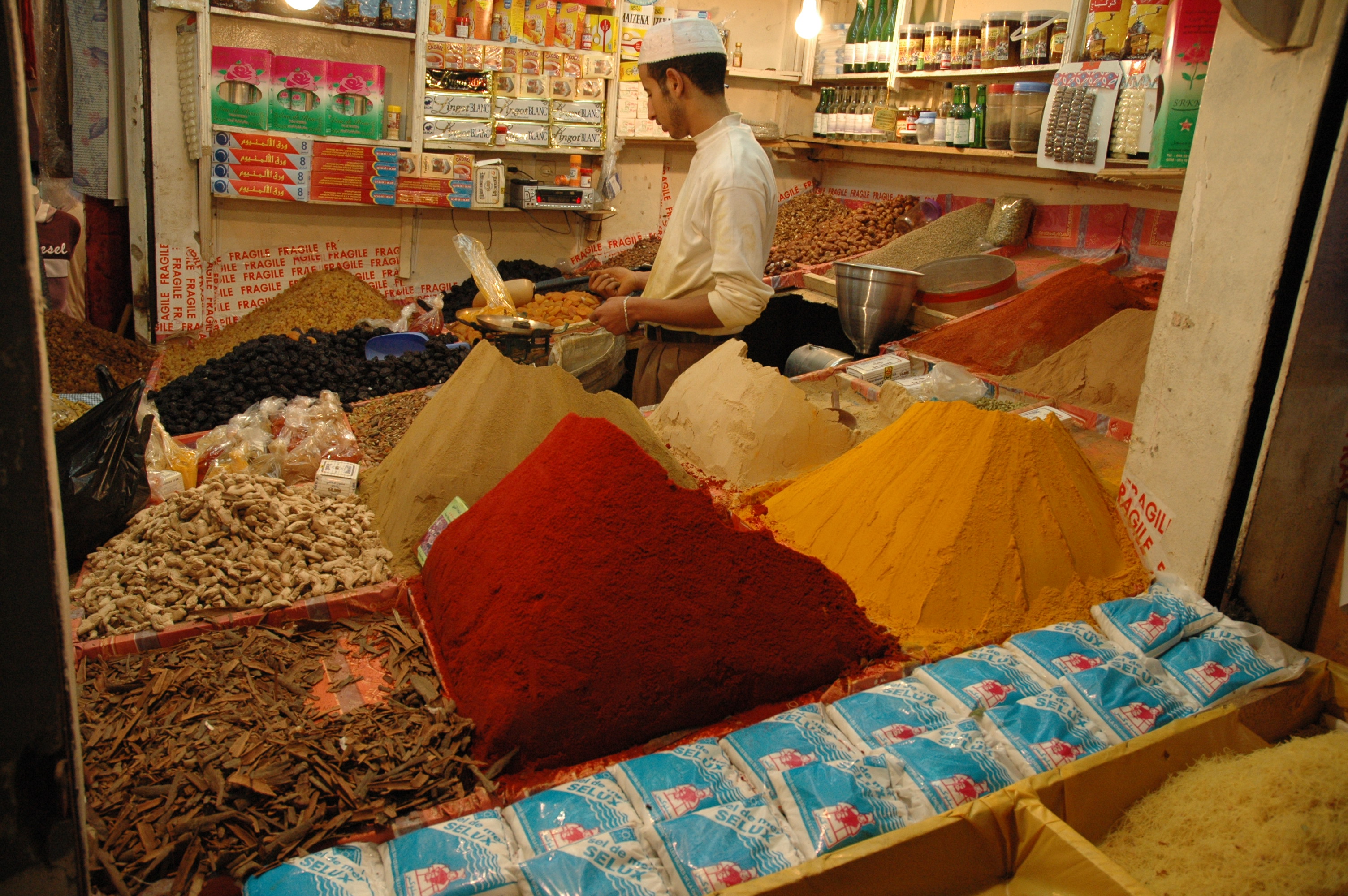
That afternoon ended at a market the size of a football field—clothes, fruit, vegetables, spices, olives, people on every side. Mohamed and Brahim pushed us through to a dried-fruit-and-spice stall and negotiated for spices while we stood useless beside them.
Getting back out took as long as getting in. We stopped at one last café for coffee and hot chocolate, and said goodnight to Mohamed and Brahim.
The next day, we walked to the Hassan II Mosque—the third-largest in the world—which is set right on the Atlantic. You could only go in with a tour. We walked up to the entrance, looked in, and left it at that. It felt like enough. Surfers worked a break just off the rocks below, riding it like the mosque wasn't there.
Later, the internet was cheap, so we spent the afternoon catching up on email. I broke off to find a phone and let Mohamed and Brahim know we'd meet them that evening.
On the walk back, a man fell in beside me, talking in perfect English. We walked a while. Then he wanted money. I told him no. He asked for a cigarette. I didn't have one. At the door of the internet café, he was still at it, calling me a liar. I walked inside.
As I walked in, I heard him spit.
I didn't know if it was aimed at me. I didn't feel anything. Inside, I asked Tina if there was anything on my back.
There was.
Before we met the others, I stopped for a sandwich at a small shop on the main road. I couldn't read French or Arabic, so I pointed at a couple of words. "This one."
"For here or takeaway?"
English. I laughed. "Oh—you speak English. What did I just order?"
"Meat."
I think it was chicken. I'm still not sure.
For the rest of the night, we sat with Mohamed and Brahim at the coffee shop, talking.

