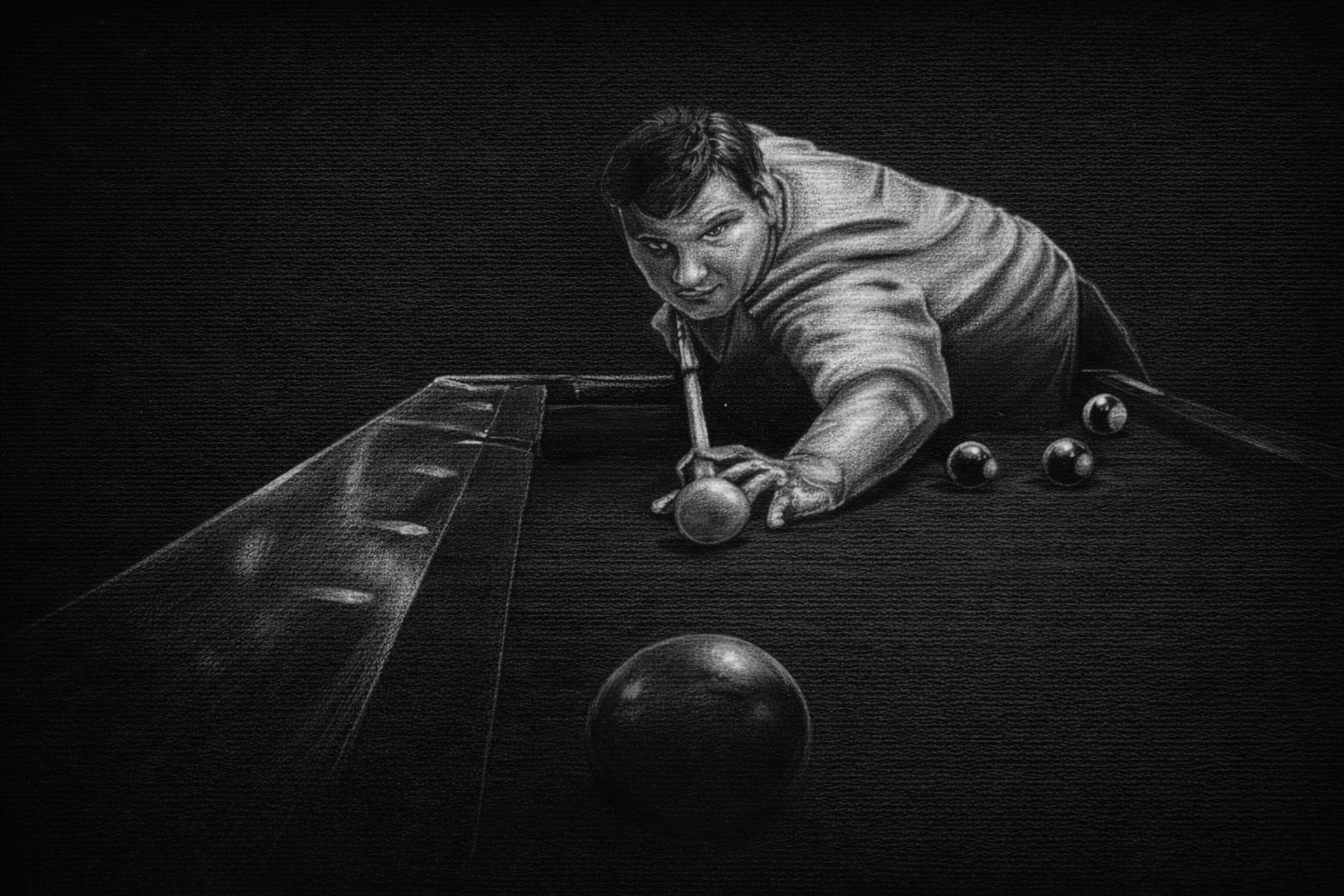
Holding the Table

February 11, 2026

book


In 2002, I played in the U.S. Amateur Pool Tournament in Laurel, Maryland. To get there, I had to be one of the top players in the APA league and one of two winners from a qualifying tournament. Denver was one of only twelve cities in the country to host a qualifier, and ours was held at Shakespeare’s pool hall.

The same pool hall I played in after getting laid off from Spiremedia.

The same one, only a few miles from my house.

This tournament would be my last hurrah with pool. I didn’t know it yet, but Laurel would be the end.

Up to that point, pool wasn’t just something I did — it was something I was. It was baked into me, a family pastime passed down through generations. I watched and played pool with my father, my grandfather, and even my great-grandfather.

* * *

I grew up with a pool table in the basement. For years, I told people I started playing when I was five, but the truth is simpler: the table was there the day I came home from the hospital. My parents bought the house — and the table — in 1974, the year I was born. If I started earlier, I wouldn’t be surprised.

Out of everyone before me, my father was the most serious player. That seriousness became part of my upbringing. I don’t know exactly when I started playing, but I remember him dragging a chair around the table so I could stand high enough to reach the felt.

He taught me the bridge first. How my left hand shaped the cue’s path. A closed bridge — pointer finger and thumb wrapped tight, the other fingers planted. Or an open bridge — thumb pinched to finger, cue sliding clean across the top. I used both instinctively, depending on what the table demanded.

Then came angles. Cueball control. English.
He explained it like a clock.

Twelve o’clock to follow through.
Three to move right.
Nine to move left.
And six o’clock — the hardest shot — ripped the cue ball back toward you like it was on a yo-yo.

When you hit that shot clean, people noticed. Onlookers would yell, “Oh damn.” Naturally, that became the one I obsessed over. It wasn’t always the smart shot, but it was the one that announced you knew what you were doing. It got into your opponent’s head.

My dad watched my progress with quiet pride. The guys came over to drink beer and play pool. Many nights, I was the opening act — five years old, standing on a chair, dropping balls and jaws at the same time.

I fell in love with the game — and with the praise.

The colored balls: solids and stripes, numbers floating in clean white circles.
The crack of the break.
The satisfying clatter of a ball running down the return track.

It was a bar table, so the balls fed back into the holding area — the kind that usually needed a quarter to release them. At home, no quarter was required. Just a firm shove on the coin mechanism.

Blue chalk stained my fingers. A bottle of Johnson & Johnson baby powder was always within reach. Back then, we used it freely. Two taps — never more — dusted a cupped left hand. The cue slid through it, slow and smooth. The right hand guided; the left set the line. Powder bloomed, then settled — on felt, on wood, on skin. Chalk, powder, and the musty Midwestern basement air.

To this day, the smell of baby powder takes me straight back to that room.

* * *

Each rack was a puzzle. Each break, a new problem to solve. Pool sharpened my spatial awareness. I didn’t have language for it then — only results. I could see angles others missed. I could hold entire tables in my head.

For a while, pool stepped aside. Baseball. Football. Basketball. That carried me through freshman year. But by sophomore year, it was clear this five-foot-ten white kid wasn’t going to dominate on the court.

Around that time, the smokers — the dirties, as everyone called them — gathered at Mr. G’s corner store, which had two pool tables. These were my friends. I didn’t smoke. I was the outsider who still played sports.

I quit basketball and started joining them for lunch. If you arrived early enough, you could squeeze in four games.

My parents gave me two dollars a day for lunch money. The routine never changed.

Walk to the gas station.
Buy a Little Debbie Nutty Buddy for a dollar.
A Mountain Dew for fifty cents.
That left fifty cents for pool.

Enough for one game — unless you won.

If you won, you held the table. That was the goal. Keep playing. Earn recognition. Maybe catch the attention of a girl watching nearby.

By then, I was better than my peers. Good enough to challenge my father.

That’s when he taught me the art of shit-talking.

Not as a lecture — more like a lion keeping a cub in check. He’d talk just enough to raise the stakes. Call the next crazy shot. Back it up. Or slip in a hustler’s nudge:

“There’s a lot of pressure on this one.”

“Don't miss that easy shot for the win.”


Sometimes he said it before I even walking up to the eight ball.

Naturally, I fired back. That rhythm lasted our entire lives. We only see each other once a year now, but the same pool table still sits in their house. We talk shit. Call ridiculous shots. My celebrations are loud and ridiculous. His are quieter — a wink, a nod — got that one, son — followed immediately by more shit-talk.

* * *

Around fourteen, something shifted.

My parents were in their late thirties. My brother Jason had a car. On many weekends, my parents went out with friends. Jason was often gone. I was left home alone. Trusted. Mostly responsible.

That’s when I truly honed my craft.

Just me and the table.

Rack after rack. Chasing that flashy backspin shot. Late-game scenarios with only a few balls left, I’d pick one target and map every possible way to sink it.

Direct cut.
One rail.
Three rails.
Rail-first.
Two rails before contact.
Caroms.
Combinations.

Could it be done?

Again and again, I wasn’t practicing to beat my dad or my friends. I was solving problems for the pleasure of solving them. Hours disappeared. Boredom never showed up.

The cue became my shield.
My weapon.
My confidant.

* * *

By thirteen, I was already sneaking into bars.

The Jet Lounge was close to my house, and that’s where the real gambling lived. Not big money — but enough to make your stomach tighten. Grown men sized you up not by your age, but by your stroke. Hustling might be a stretch, but if I could scrape together a few bucks, I’d gamble. Fifty cents a game. A dollar if I were feeling brave.

The regulars didn’t care how old I was as long as I paid when I lost, didn’t boast when I won, and didn’t whine about table rolls.

The Jet was my classroom. Smoke thick enough to chew. A jukebox that never rested. A crowd that spotted weakness before you chalked your cue. I learned more there than I ever did in school — how people bluff, how they brag, how they fold.

* * *

But the Jet wasn’t where we spent most of our hours.

That was Cadillac Lanes — the bowling alley with three pool tables tucked into the corner. That’s where the high school kids played. The games were different. More casual. No less competitive.

If you wanted the next game, you slid a single quarter onto the table, tucked just under the rail above the coin slot. That quarter was your flag. Your challenge.

The rail filled with silver stacks — little metal soldiers lined up in formation, each one waiting to knock you off the table.

It wasn’t about money. It was about status.

The winner stayed. The challenger paid. If you kept winning, two quarters could last all night. The longer you held the table, the louder the room grew — kids leaning in, calling shots, the clack of balls echoing off the lanes.

Holding the table felt like holding court.

And I loved it.

Cadillac Lanes made you sharp.
The Jet Lounge made you dangerous.

Between the two, I learned every angle a cue ball could spin — and how quickly pressure changed people.

* * *

Around the same time, I started devouring biographies. Hustlers. Moguls. Musicians. Explorers. Anyone who bent the world in their direction. Not to copy the behavior — to learn the thinking.

Reading sharpened my eyes.
The Jet sharpened my instincts.

Whether I knew it or not, I was training the same muscle — two quarters at a time.


Want to read more stories like this?
9 Lives & Counting is my memoir of mischief, close calls, and the lessons learned from testing every limit I could find.
Coming June 2026.